For founders, operators, and finance leaders tired of the drag
Your organization has no delete key.
Everything in your company was easy to start. The meetings, the tools, the reports — ending them is nobody's job. Fewer is the platform that owns that job: it finds what's stopped earning its keep, shows you the evidence, and ends it. With an undo for every cut.
Organizations only know how to add.
Every recurring commitment in your company was created by someone, for a reason, in minutes. The meeting made sense during the launch. The weekly report answered a real question. The alert channel was born in an incident. The subscription solved a problem.
The reasons ended. The commitments didn't — because creation has owners and champions, and removal has nobody. Your calendar is a sediment layer of past emergencies. Your reporting stack is a museum of former priorities. Your software bill is a list of decisions nobody remembers making.
Add up the unused seats and the dead meetings and you'll get a number worth recovering — six figures, usually. That's not why you should care.
The real cost is drag. Every standing commitment takes a slice of somebody's attention — and slice by slice, your company's attention is spent before it reaches the thing you built the company to do. Decisions need three meetings. Launches slip a week, then a quarter. Your best people spend their days feeding the machine — and their evenings doing their jobs.
A company is a machine for turning ideas into things customers pay for. Every commitment adds a step between the two — a meeting the idea has to survive, a report it has to appear in, a tool it has to be tracked in. The companies that feel fast aren't smarter. They have fewer steps between input and output — and they guard that number harder than they guard headcount.
A company that does less on purpose moves faster than one that does everything by accident. Focus isn't a poster in the break room. It's an operating advantage — and it's the thing Fewer is built to win back.
You've tried. It grew back.
One memorable Friday, someone cancels every recurring meeting on the calendar. It feels incredible. By spring the calendar is full again — because a purge is an event, and the thing that fills your calendar is a process.
You bought a tool that shows you the waste. Now you have the waste, plus a tool that shows it to you. Between seeing and ending sits the hard part — an awkward conversation nobody is paid to have — and dashboards don't have conversations.
AI notetakers, meeting summarizers, license negotiators. Each one takes something that maybe shouldn't exist and makes it cheaper to keep. Twenty years of software has been optimizing what it should have been deleting.
None of these can end anything. Ending is the missing capability — so that's the product we built.
One question, asked of everything.
Fewer plugs into the systems where commitments hide — calendars, chat, the software stack — and asks that question of every recurring thing it finds. Who needs it? What does it cost? Who owns it? What breaks if it stops?
Plenty of things have an answer — the Monday sync where decisions actually get made, the alert channel that catches real fires. Those stay, with a named owner and a reason on record.
But every company is carrying things that can't answer. The status report that outlived the status. The 80-seat tool with 12 people in it. The weekly hour that exists because it existed last week. For those, Fewer doesn't hand you a scorecard or a gentle nudge. It hands you a decision, ready to make:
“We've always done this” doesn't count as an answer. Habit isn't a reason — habit is the thing we're hunting.
An example — illustrative data.
How it works
Twenty-four hours later, you're looking at something you've never seen: every recurring commitment, in one place, priced in hours and dollars. Most leaders find something indefensible in the first ten minutes.
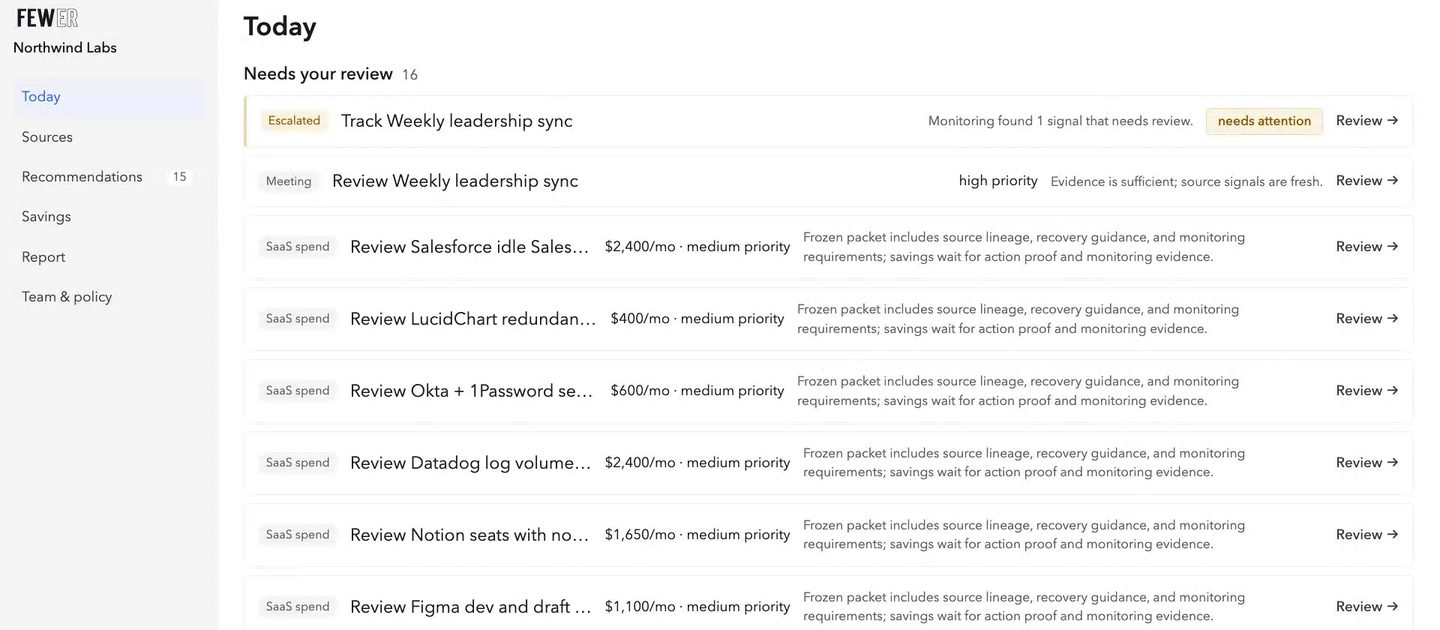
The review queue in Northwind Labs, our demo workspace.
Thirty minutes to connect. The full picture in 24 hours. First cuts inside a week.
We cut deep on purpose.
Most tools are built to never be wrong — so they only ever recommend what's already obvious, and nothing really changes. Fewer runs on a different bet: cut deep, keep the receipts, and let reality do the review.
Cutting deep means some cuts come back. Good. If every removal sticks, you were only trimming the safe stuff, and the drag survives. We expect roughly one cut in ten to turn out partly needed — and when it does, it doesn't return as it was. It returns as the smallest thing that solves today's problem: the hour becomes twenty minutes, the all-hands channel becomes an incident line, eighty seats become four.
How much came back, and how much smaller — that's on your ledger, in plain sight. It's how you know the cutting was real.
If nothing ever has to come back, you didn't cut deep enough.
Deletion you can trust.
Before Fewer ends anything, it takes a complete snapshot — the who, the what, the settings, the history. Every recommendation shows how fully, and for how long, it can be restored — before anyone clicks approve.
A dying meeting is a design failure, not a performance failure. Fewer carries no individual scores, no rankings, no surveillance — and never will. It reads the calendar, not the person; the license list, not the employee. If you want a tool that watches your people, we're not it.
Fewer reads what pricing a commitment requires, and nothing more. Credentials live in an encrypted vault — never in our database, our logs, or our code. Everything that reaches an AI is screened for secrets first, and no AI ever acts on its own: every removal traces back to a named person who approved it. How we handle data →
Safe doesn't mean timid. Safe means reversible.
We measure one thing.
Hours that don't come back. Spend that doesn't reappear under a new logo. Cuts that get rebuilt count against us, on a ledger you can read any time — not in a highlight reel we assemble for renewal season.
An example ledger — illustrative data.
Most software shows you a dashboard of what it did. Fewer hands you a ledger of what's gone.
Built for your stack.
Fewer works through the systems you already run — deep on a few rather than shallow on hundreds.
Supported at launch
Early access is open.
We take twelve companies per cohort — small on purpose: you work with the team that built it, and the results get checked hard enough that nobody can argue with them.
What happens when you ask: we reply within a business day. One 30-minute working session to scope the engagement and confirm your stack. Then the clock you've already seen: thirty minutes to connect, the full picture in 24 hours, first cuts inside a week.
Your company has a thousand ways to add.
Built to cut deep — everything it removes can be brought back.